Activities · The highlands and the volcanoes
Pura Besakih, the mother temple
The highest and most important temple complex in Balinese Hinduism, built up the flank of Agung, and for years the worst-reviewed approach on the island. What the complex actually is, and how the visit is organised now.
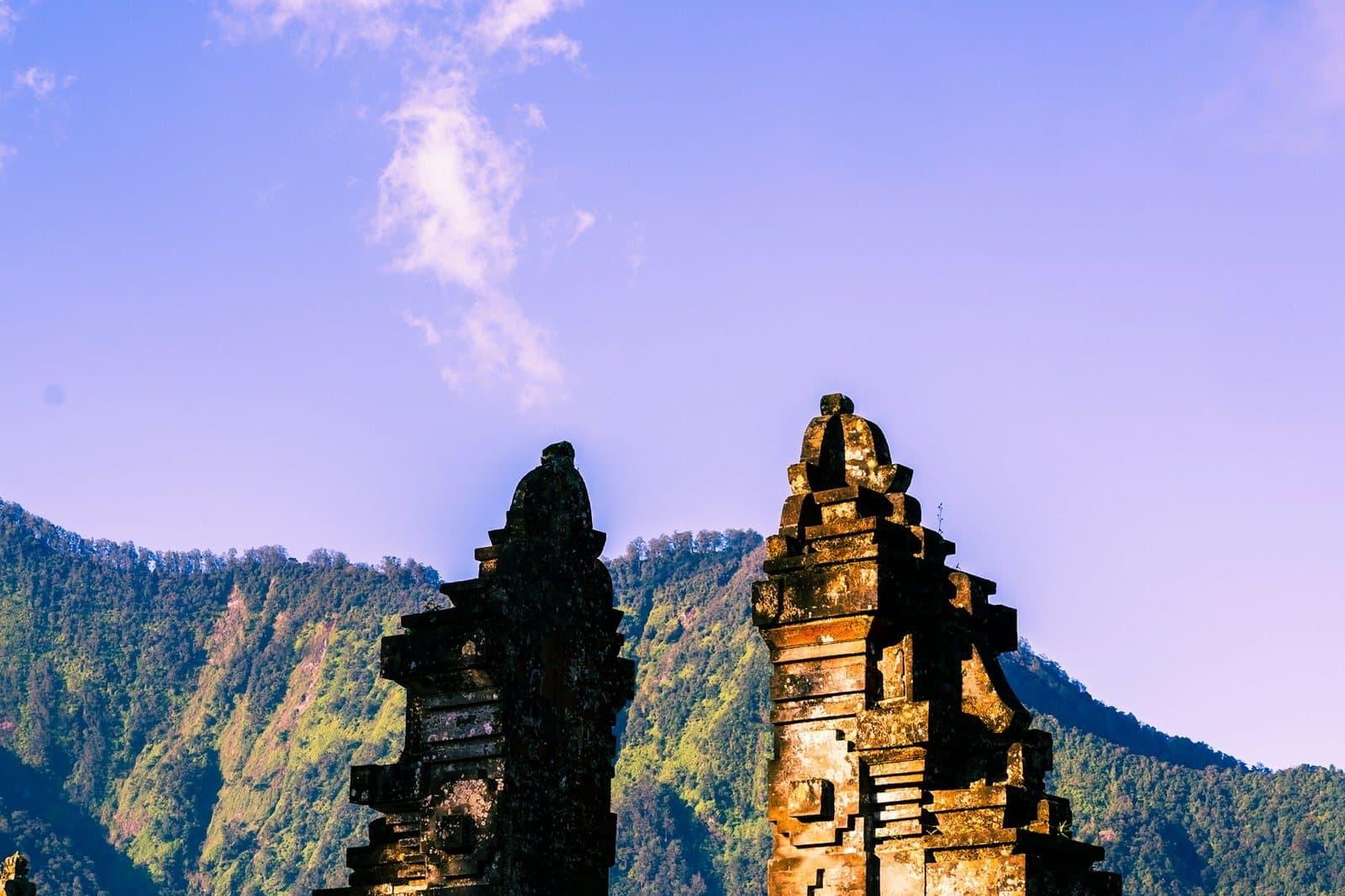
Climb the stone stairway from the parking terrace and Besakih announces itself gate by gate, split doorway opening onto split doorway, black volcanic stone climbing with the path toward Agung's cloud line. This is Pura Besakih, the mother temple, the highest sanctuary in Balinese Hinduism, and for years the walk up to it was also the worst-reviewed few hundred metres on the island, not because of the temple but because of who worked the approach in front of it.
What Besakih actually is
Besakih is not one temple but a complex of many, spread across terraces up the southwestern slope of Mount Agung and centred on Pura Penataran Agung, the largest and highest of the group. Around it stand temples dedicated to the Hindu trinity and to clans and regions across the island, each with its own courtyards, gates and shrines, connected by staircases and gateways rather than a single path. It is the mother temple in a literal sense: many Balinese families trace an ancestral tie to one shrine within the complex, and the whole mountain of stone functions as the island's central place of worship. A visitor who tries to see all of it in one pass will run out of morning before running out of temples; most visits cover the central sanctuary and its immediate neighbours, the split candi bentar gates and the tiered meru towers that are the site's signature silhouette against the mountain.
Sarong, sash, and the new front door
Entry requires a sarong and a sash at the waist, provided at the gate for anyone who arrives without one, and shoulders covered as at any working temple. The approach itself has been rebuilt: the province reorganised the visit with an official parking and ticketing area below the complex and a shuttle running visitors up to the temple gates, replacing the informal scrum of touts and vehicles that used to meet arriving cars. A cost exists for entry and for the shuttle; we publish none until we can date them from a source.
The pressure at the gate, honestly
Besakih earned a rough reputation for years among independent travellers, who reported self-appointed guides pressing visitors for paid guiding or donations that were never required, sometimes insistently, right at the point of arrival. The official entrance and shuttle arrangement exist partly to fix exactly this, routing visitors through a ticketed gate rather than a car park full of freelancers. The plain advice still holds: use the official entrance, carry small sarong money for the counter if you need one, and decline any unsolicited offer of guiding or a donation book politely and without stopping to negotiate.
When the temple belongs to worshippers
Besakih is a working temple complex, not a museum, and on ceremony days the courtyards fill with Balinese families in full ceremonial dress rather than tour groups. Ordinary visiting continues around the edges of a ceremony, but the inner sanctuaries on those days belong to worshippers first, and a respectful visitor times a closer look for a quieter day rather than pushing into an active rite for a photograph.
Agung makes its own weather
Agung is tall enough to generate its own cloud, and the summit above the temple is often wrapped in it by mid-morning even on a clear coastal day. The seasonal guide is the honest reference for which months give the best odds of a bare peak; the practical rule at Besakih is simply to arrive early, since the mountain that gives the temple its meaning is also the first thing the day's weather takes away.
Where to base for it
Besakih sits on Agung's flank in Karangasem, within reach of two very different bases: Sidemen, the terraced valley below the mountain's southern side, and Kintamani, the caldera rim to the northwest that trades one volcano's view for another's. Either puts Besakih inside a short morning drive rather than a long haul from the south, the same arithmetic that makes the Gates of Heaven at Lempuyang worth combining with it on an eastern loop. The gates keep climbing the mountain whether or not the summit ever clears for you.