Activities · The east coast
Tirta Gangga water palace
A royal water garden of pools, fountains and stepping stones, damaged by the 1963 eruption of Agung and rebuilt: a young monument on an island full of ancient ones.
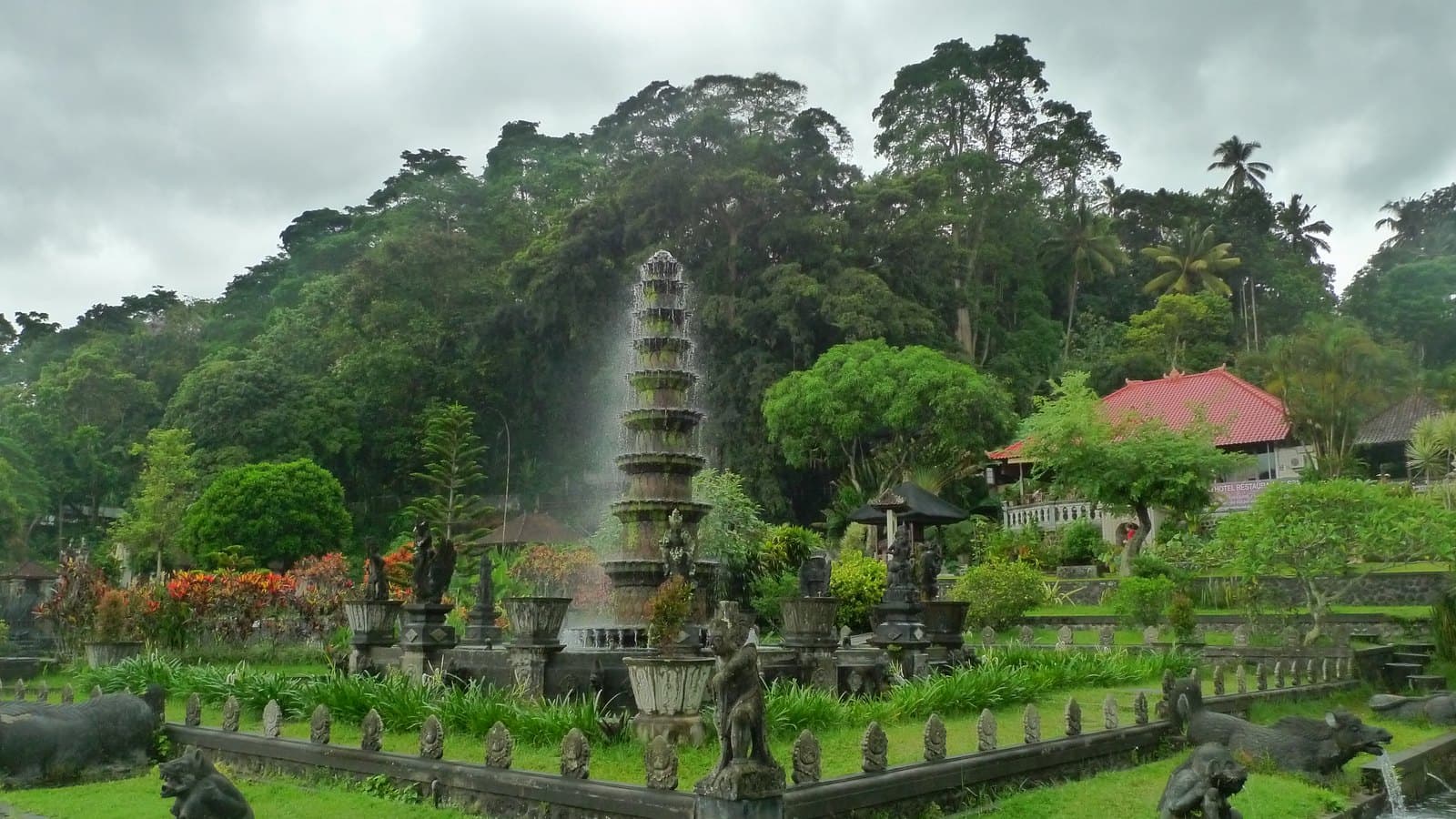
Bali's great temples measure their age in centuries. Tirta Gangga does not: a royal water garden of pools, fountains and stepping stones built in the middle of the twentieth century, wrecked within a generation by the mountain that looms over it, and rebuilt after. It is one of the few sites on the island designed to be walked through rather than looked at, and its youth is part of what makes it worth the stop.
What it is, and who built it
Tirta Gangga was the water palace of the last raja of Karangasem, laid out around ornamental pools fed by a natural spring, with fountains, statuary and stepping stones set across the water rather than a single formal path. It was built as a royal pleasure garden in an era when Bali's kingdoms still commissioned such things, and it reads more like a garden designed for wandering than a temple built for worship, which is exactly what sets it apart from almost everywhere else on the itinerary.
The eruption and the rebuilding
Mount Agung erupted in 1963, and the water palace, close enough to the mountain to feel it directly, was badly damaged in the disaster. What stands today was rebuilt afterward, following the layout of the original garden rather than replacing it with something new. That history makes Tirta Gangga a genuinely young monument twice over: young when it was built, and young again when it was remade, which is unusual on an island where most sacred sites claim centuries of continuous history.
The stepping stones
The garden's signature is a set of stone steps laid across its largest pond, spaced so that visitors cross the water on foot between the koi swimming beneath them, stone to stone rather than around the edge. It is the one moment in the visit that asks something physical of a visitor rather than simply a walk between courtyards, and it is why photographs of Tirta Gangga nearly always show the same crossing. Around the ponds, narrow paths link fountains, statues and shaded corners that reward slow wandering over a quick circuit.
The spring underneath it
The palace exists where it does because of the spring that still feeds its pools, a natural water source considered significant enough that the site's name pairs the Balinese word for holy water with the Ganges, the river held sacred across Hindu tradition. The garden was built around that water rather than the water being brought to the garden, and the pools still draw from the same source today.
Pairing it with Lempuyang
Tirta Gangga sits on the same road as the Gates of Heaven at Lempuyang, close enough that the two are usually visited on the same morning, the temple first while the mountain behind it still has a chance of clear sky, the water palace after as a slower, cooler stop on the way back down. Travellers based in Candidasa or Amed have the easiest run at both, and the travel time matrix prices the loop honestly against a there-and-back day from the south.
When to go
Early morning gives the ponds their stillest water and the fewest other visitors on the stepping stones, before the tour groups working the Lempuyang loop arrive in the middle of the day. Later in the morning the same crossing becomes a queue for the photograph rather than a quiet walk across the water.
A heron stands motionless at the pond's edge, ignoring the visitors picking their way across the stones a few feet away, waiting for whatever the koi stir up next.