Out of date. We have not verified this in too long. Do not rely on it.
What happens if you overstay your visa in Bali

What is the fine for overstaying your visa in Bali?
Rp 1,000,000 per day up to the 60-day line, set by tariff regulation and not by the immigration law. Not paying converts it into deportation and a five-year ban, extendable, which Permenimipas 13/2025 Pasal 24(1)(c) ends once the arrears are paid and an official determines it. (verified 6 September 2026)
In force since
Every page on this subject quotes Rp 1,000,000 per day. The figure is right. It is not in the immigration law, and the most expensive consequence is missing everywhere. To see what your own dates add up to, use the overstay calculator.
The law sets no amount
Pasal 78 ayat (1) of the immigration law covers an overstay under 60 days.
Orang Asing pemegang Izin Tinggal yang telah berakhir masa berlakunya dan masih berada dalam Wilayah Indonesia kurang dari 60 (enam puluh) hari dari batas waktu Izin Tinggal dikenai biaya beban sesuai dengan ketentuan peraturan perundang-undangan.
A charge, biaya beban, set in accordance with the applicable regulations. The statute delegates the number. That is why it can change without the law changing, and why quoting it as "the law" is wrong.
Where the number actually lives
PP No. 45 Tahun 2024, the government regulation on non-tax state revenue, Lampiran angka VI, heading Denda Administratif:
A. Biaya Beban, 1. Orang Asing yang Berada di Wilayah Indonesia Melampaui Waktu Tidak Lebih dari 60 Hari dari Izin Keimigrasian yang Diberikan. Satuan per hari. Tarif Rp 1.000.000,00
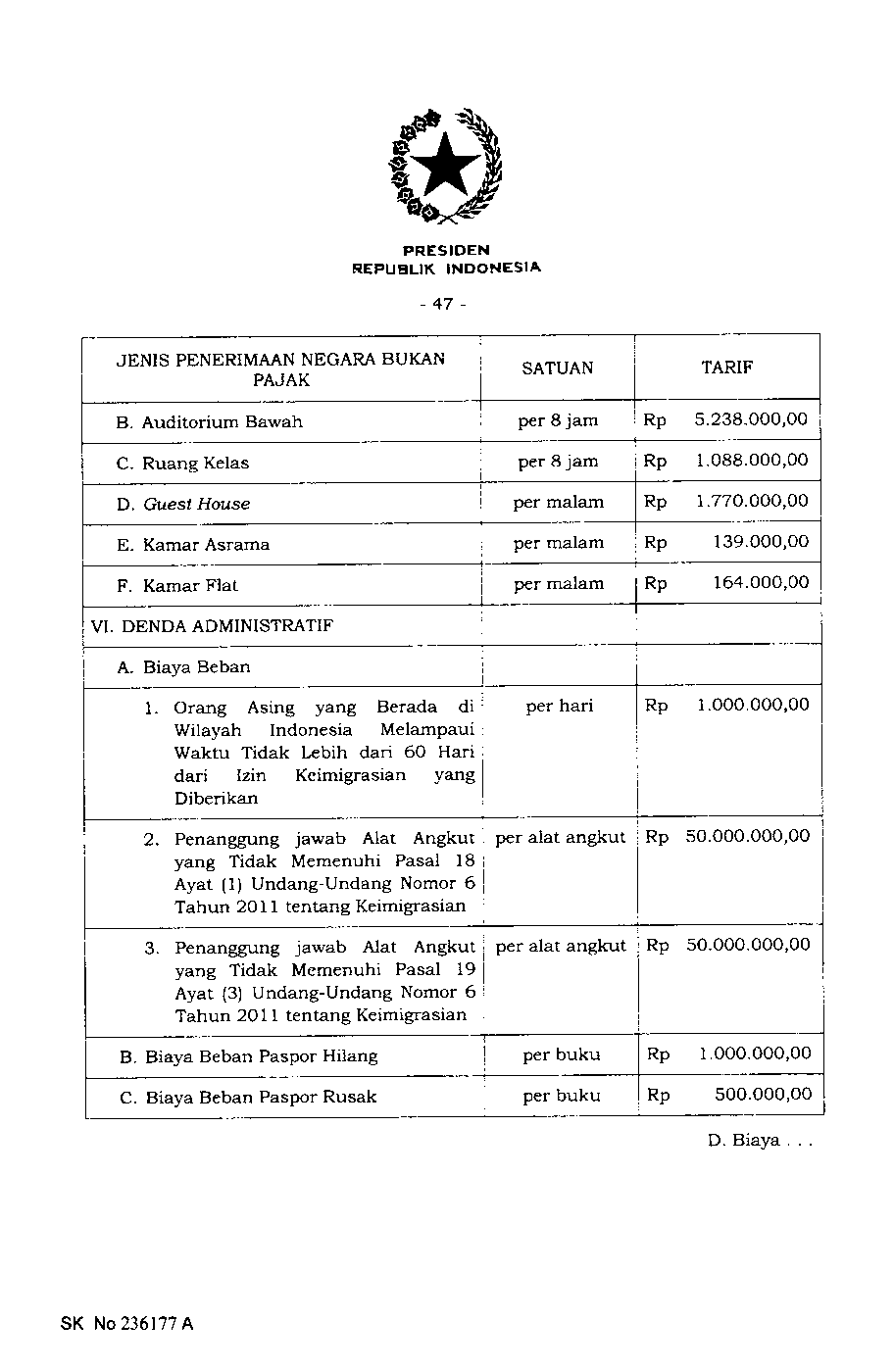
That is the source everyone should be citing. A dated notice from the Surakarta immigration office, published 22 September 2025, gives the same figure and adds that it counts from the first day of overstay.
The Rp 90,000,000 nobody mentions
Next printed page, same annex:
E. Pencabutan Penangkalan bagi Warga Negara Asing yang Ditangkal karena Overstay Lebih dari 60 Hari atau Tidak Membayar Biaya Beban. Satuan per permohonan. Tarif Rp 90.000.000,00
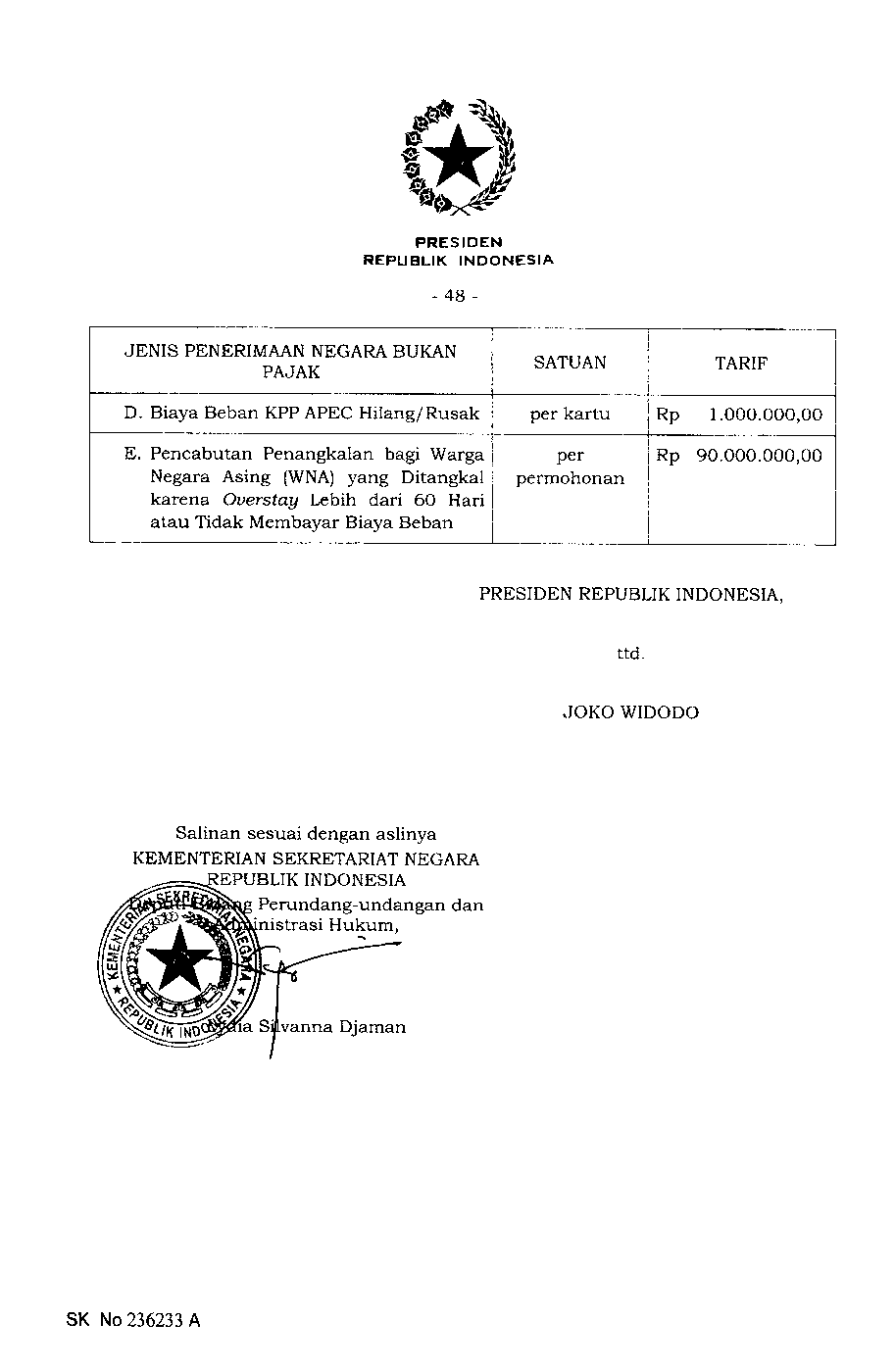
Read the unit. This is the price of an application to have a ban lifted, not a guarantee that paying it lifts one. Nothing in the regulation says the application succeeds.
We have not found this figure on a single travel page in either language. It reframes the subject. A ten-day overstay is a ten-million-rupiah inconvenience, and refusing to settle it leads to a ban. One door out is a petition priced at nine times that, with no promised outcome. The other, further down, is paying what was owed.
Not paying is not the cheap option
Pasal 78 ayat (2):
Orang Asing yang tidak membayar biaya beban ... dikenai Tindakan Administratif Keimigrasian berupa Deportasi dan Penangkalan.
Not paying, whether you refuse or simply cannot, triggers deportation and a ban, the same outcome as a 60-day overstay.
The law also allows detention. Pasal 83 ayat (1):
Pejabat Imigrasi berwenang menempatkan Orang Asing dalam Rumah Detensi Imigrasi atau Ruang Detensi Imigrasi jika Orang Asing tersebut: a. berada di Wilayah Indonesia tanpa memiliki Izin Tinggal yang sah atau memiliki Izin Tinggal yang tidak berlaku lagi.
A permit that is no longer valid is ground (a). An overstayer can be placed in an immigration detention centre or detention room; the article gives the official the power, it does not oblige its use.
The 60-day line, and why sources disagree about it
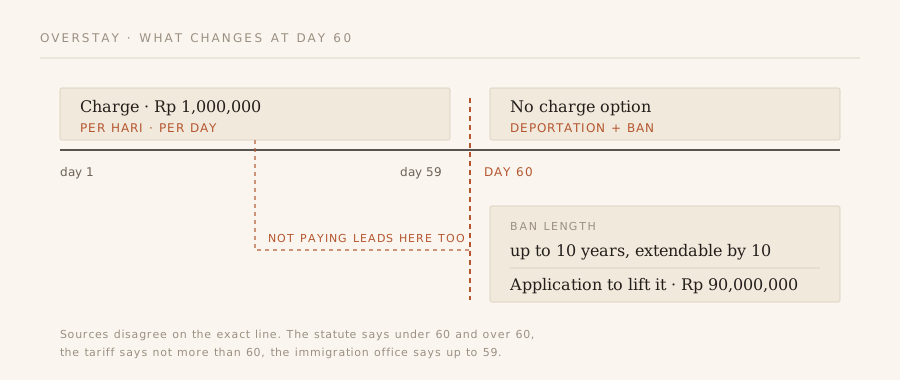
Past 60 days, Pasal 78 ayat (3) removes the charge option: deportation and a ban follow administratively. This is a cliff, not a slope.
Where exactly the cliff falls depends on which instrument you read, and we are not going to pick one silently:
- the statute charges an overstay of less than 60 days and deports at
- more than 60, saying nothing about day 60 itself;
- the tariff regulation applies the charge at not more than 60 days;
- the Surakarta immigration office states the charge applies up to 59 days.
If you are near the line, treat day 59 as the last safe day.
Pasal 102 ayat (1), as amended in 2024, sets the outer bound:
Jangka waktu Penangkalan berlaku paling lama 10 (sepuluh) tahun dan dapat diperpanjang paling lama 10 (sepuluh) tahun.
Up to ten years, extendable by up to ten more. That is a ceiling, and the whole market prints it as though it were the figure. It is not the figure for this situation.
The implementing regulation says which ground gets which term. Permenimipas No. 13 Tahun 2025, in force since 16 December 2025, sets the duration at Pasal 18. Point (a) covers a ban caused by deportation or by melampaui waktu Izin Tinggal yang tidak membayar biaya beban, overstaying without paying the charge, which is precisely the path this page describes:
5 (lima) tahun
Five years. The ten-year tier at point (b) is for transnational organised crime, suspected acts against public order, decency, religion or Indonesian customary practice, and criminal sentences of up to five years. A lifetime ban, at point (c), covers a longer list again: national security, sovereignty and terrorism among them, but also forged documents, communicable disease, radicalism, violent or sexual offences, narcotics, trafficking, people-smuggling, evading punishment abroad, and sentences over five years. Each tier closes with the same residual clause, other grounds the Minister sets, at (a)(3), (b)(4) and (c)(15). The Minister's reserve power sits at all three lengths, not only at ten years.
So a traveller who overstays, does not pay, and is deported faces five years, not ten. Five years is the starting term, though, not a guaranteed end. Pasal 23 of the same regulation lets five named officials, from the Directorate's directors to the head of an immigration office or detention centre, ask for more:
Direktur ... mengajukan permohonan perpanjangan Penangkalan kepada Direktur Jenderal melalui aplikasi cegah dan tangkal SIMKIM
The article is generic and limited to no ground, and Pasal 102 ayat (1) caps any extension at ten years. Where no application is made, Pasal 23 ayat (2) ends the ban by operation of law: Penangkalan berakhir demi hukum, and Pasal 102 ayat (2) of the statute reaches the same result where no extension decision is taken. The ten-year ceiling exists, and it is not aimed at the overstayer; the five years can still be lengthened on a request the traveller does not see.
A ban for not paying ends when the arrears are paid
Pasal 24 ayat (1) of the same regulation lists how a ban ends, and point (c) is the one no page mentions:
Penangkalan berakhir karena: ... c. yang bersangkutan telah memenuhi kewajiban membayar biaya beban atau denda ketika dikenakan Tindakan Administrasi Keimigrasian.
This exit is not free. It costs the arrears, Rp 1,000,000 for each day of the overstay that caused the ban, Rp 59,000,000 at day 59. What it does not cost is a further fee. And Pasal 24 ayat (2) requires the end to be ditetapkan oleh Menteri atau Pejabat Imigrasi yang ditunjuk: paying is not self-executing, an official has to record it.
It also only exists where something was owed. Past the 60-day line, Pasal 78 ayat (3) imposes no charge at all, deportation and the ban follow directly, so there are no arrears to discharge and point (c) has nothing to bite on. The tariff line for lifting a ban says as much: it prices the case of a foreigner banned karena Overstay Lebih dari 60 Hari atau Tidak Membayar Biaya Beban, both regimes, while the payment route covers only the second. For the long overstayer, the door is the petition below: deportation under Pasal 17 ayat (4) huruf e makes that ban a Pasal 17 ayat (3) ban, which Pasal 26 reaches. Pasal 24 ayat (1) huruf b, "dicabut oleh Menteri", is a ground on which a ban ends, with no applicant or procedure attached, so it is not a door anyone can knock on. That a paid charge is the only thing point (c) can bite on is our reading of "biaya beban atau denda"; the text does not tie the arrears to the ban's cause.
That matters because the Rp 90,000,000 above is not the only door. That fee, in PP 45/2024, prices an application to lift an overstay ban. Pasal 26 of Permenimipas 13/2025 is the guarantor's petition, and the only application route to a pencabutan Penangkalan the regulation contains. Read together, the fee attaches to the Pasal 26 petition. That is our reading, not a statement either instrument makes: the tariff names no guarantor and predates the ministerial rule by fourteen months. Paying what was owed is a separate route, and on the face of the regulation a more certain one.
When the charge can be zero
Pasal 7 ayat (1) of PP 45/2024 allows a tariff of Rp 0 for a foreign national who is hospitalised for mental illness, in keadaan kahar (force majeure), in Indonesia and unable to pay, being deported, held by law enforcement, or executing a court decision. Its wording is dapat dikenakan, may be applied.
The rule that turns that into a procedure exists, and until 6 September 2026 this page said we had not read it. Permen Imipas No. 14 Tahun 2025, in force since 22 December 2025, is made, in its own words, untuk melaksanakan ketentuan Pasal 5 ayat (6) dan Pasal 7 ayat (3) Peraturan Pemerintah Nomor 45 Tahun 2024. Its BAB VII deals with the overstay charge itself: Persyaratan dan Tata Cara Pengenaan Tarif Nol Rupiah Terhadap Biaya Beban Orang Asing yang Berada di Wilayah Indonesia Melampaui Waktu Tidak Lebih dari 60 (Enam Puluh) Hari.
Pasal 23 repeats the six categories and drops the PP's dapat:
dikenakan tarif sebesar Rp0,00 (nol rupiah) kepada Orang Asing yang: ... c. berada di Indonesia dan tidak mampu
Pasal 24 sets the route. The foreign national, or their guarantor, applies to the Kepala Kantor Imigrasi for the area where they live, with a document for the ground claimed: a letter from a doctor at a psychiatric hospital; a government or police statement for keadaan kahar; a recommendation from the regional government, at no lower a level than the local Dinas Sosial or its equivalent, for the person in Indonesia and unable to pay; a letter from the police, prosecutor or court; or a final court judgment. Pasal 25 exempts a person being deported from applying at all. Pasal 26 makes the approval the operative act: the zero rate applies once the application is granted, and if it is refused the charge is due.
So the traveller who cannot pay has a counter to go to and a document to bring. Whether that counter says yes is a question the regulation does not answer, and neither do we.
Is this regulation still in force?
Yes for these tariffs, and the check is worth showing. PP No. 30 Tahun 2026 replaced parts of PP 45/2024 with effect from 1 August 2026. Its revocation clause covers legal services, drafting training, intellectual property, use of facilities and civil-service competency assessment. Immigration services and administrative penalties, where both figures above sit, are not in that list and remain in force. PP 45/2024's status page at BPK, read on 6 September 2026, lists that partial repeal and no other entry affecting it.
What we could not establish
- Whether a guarantor petition to lift a ban, once paid for, is commonly
- granted. The regulation describes the procedure; it publishes no outcome
- rate.
- What formalising the payment route under
Pasal 24 ayat (1)requires in - practice, and how long it takes.
- How often a zero-rate application under Permen Imipas 14/2025 is granted.
- The regulation names the counter and the documents; it publishes no
- decisions.
- Whether UU 11/2020 left
Pasal 78untouched. We quote it from the 2011 - text. UU 6/2023, which enacted the Perpu that replaced the 2020 text, amends
- UU 6/2011 at Pasal 1, 38, 39, 40, 46, 54, 63 and 71 only, and UU 63/2024
- does not reach it either; PP 45/2024 and Permenimipas 13/2025 both restate
- the Pasal 78 regime in its 2011 terms, which is why we rely on it.
Both amounts were read from the rendered scan of printed pages 47 and 48 of the official PDF, digit by digit. The document's embedded text layer is damaged and was not relied on. Every instrument cited here is national Indonesian law, not specific to Bali.
Prices surveyed on the ground
| Item | Amount | Surveyed |
|---|---|---|
| Overstay charge, per day | IDR 1,000,000 | |
| Application to lift a ban, per application | IDR 90,000,000 |
An amount without a survey date is worthless. These carry theirs.
Also asked
- Is the overstay fine really Rp 1,000,000 per day?
- Yes, for an overstay of up to the 60-day line. The amount is set by PP 45/2024, Lampiran angka VI, not by the immigration law itself, which delegates it. A tariff regulation can be replaced without the statute changing, which is why the source matters more than the number.
- What happens if I cannot pay the charge?
- Pasal 78 ayat (2) treats non-payment the same as a long overstay: deportation and a ban. There is a zero-rate route. Permen Imipas 14/2025 Pasal 24 lets you or your guarantor apply to the Kepala Kantor Imigrasi where you live, with a Dinas Sosial recommendation for the unable-to-pay ground. Approval is the operative act; if refused, the charge is due.
- How long does the ban last?
- Five years to start with, for a ban caused by overstaying without paying: Permenimipas 13/2025 Pasal 18(a). Pasal 23 lets five named officials apply to extend it, and UU 63/2024 Pasal 102(1) allows up to ten more years; with no application or decision, the ban ends by law. The ten years pages quote is that statutory ceiling, which allocates nothing by cause.
- Can a ban be lifted?
- Two routes. Permenimipas 13/2025 Pasal 24(1)(c) ends a ban once the charge that caused it is paid, though Pasal 24(2) requires an official to formalise it: paying is not self-executing. Separately a guarantor may petition under Pasal 26. PP 45/2024 prices an application to lift an overstay ban at Rp 90,000,000; tying that to Pasal 26 is our reading. The fee buys the application, not the outcome.
- Does the fine count from day one or after a grace period?
- The tariff gives a unit, per day, and no start date. The Surakarta immigration office states in a notice dated 22 September 2025 that it counts from the first day of overstay. That is an official statement, though not the regulation itself.
- Is 60 days the exact cut-off?
- The sources disagree. The statute charges an overstay of less than 60 days and deports at more than 60, saying nothing about day 60 itself. The tariff applies the charge at not more than 60 days. The immigration office says up to 59. Treat day 59 as the last safe day.
How we verified this
- Tariff regulation, printed pages 47 and 48 read from the rendered scan. Lampiran angka VI huruf A angka 1 (per hari) and huruf E (per permohonan); Pasal 7(1) zero-rate cases, worded dapat dikenakan; Pasal 13 entry into force
- BPK status page, read 6 September 2026: Berlaku from 17 December 2024, no uji materi. Its only history line is the partial repeal by PP 30/2026, which does not reach immigration services or administrative penalties
- Immigration law, printed p.33. Pasal 78 sets the regime and delegates the amount to regulation. Pasal 83(1)(a): an expired permit is a ground for immigration detention
- BPK status page, read 6 September 2026: Berlaku. Two MK decisions (Pasal 97(1), Pasal 16(1)(b)) and the UU 1/2023 partial repeal (Pasal 120(1), 126(e)) leave Pasal 78 untouched. Amended by UU 11/2020, Perpu 2/2022, UU 6/2023 (Pasal 106, eight articles, not 78 or 83) and UU 63/2024
- Third amendment, printed p.5. Pasal 102(1) sets the statutory ceiling at up to 10 years, extendable by up to 10 more. It is a ceiling, not the term for a given ground. Pasal 78 is not among the articles it amends
- Ban regime. Pasal 18(a): 5 years where the ban follows deportation or overstay without paying; 18(b): 10 years for graver grounds. Pasal 23: extension on application, else the ban ends by law. Pasal 24(1)(c): payment ends a ban, 24(2) formalises it. Pasal 26: guarantor petition
- BPK status page, read 6 September 2026: Berlaku, in force 16 December 2025, BN 2025 No. 1060, no uji materi, amended only by Permenimipas 1/2026. The sole source for the entry-into-force date: the promulgation field in the signed scan is blank
- Permenimipas 1/2026 status page: Berlaku from 24 April 2026, BN 2026 No. 266, amends 13/2025. The abstract names no article; the signed text in the next entry does
- Signed text of Permenimipas 1/2026, 4 pages. Pasal I amends angka 7 and angka 19 of Pasal 1 only, two definitions reworded for the ministry name change. Pasal 18, 23, 24 and 26 are untouched, so the 2025 text can be relied on as current
- Permen Imipas 14/2025, zero-rate procedure, BN 2025 No. 1103, Berlaku from 22 December 2025, no uji materi, revokes Permenkumham 9/2020. Made under PP 45/2024 Pasal 5(6) and 7(3). BAB VII, Pasal 23 to 26: six categories, application to the Kepala Kantor Imigrasi, approval as the operative act
- BPK status page, read 6 September 2026: Berlaku, in force 1 August 2026, LN 2026 No. 72. Mencabut sebagian PP 45/2024 on five heads: legal services, drafting training, intellectual property, facilities, civil-service competency assessment. Immigration is not among them
- Kantor Imigrasi Surakarta notice published 22 September 2025. Independently confirms Rp 1,000,000 per day, counted from the first day, and the 59-day limit
What changed
- Re-verified on schedule. All instruments still Berlaku, PP 30/2026 still leaves immigration alone, no PNBP text on the VOA rise. Added Permen Imipas 14/2025, the zero-rate procedure this page said it had not read. Answer, five-year term, detention, and evidence list corrected
- Re-verification, BLOCK then corrected. Found Permenimipas 13/2025, missed originally. Pasal 18(a) sets five years where the ban follows overstay without payment, not the ten-year ceiling printed here. Pasal 24(1)(c) lists payment as a ground for ending one, a route the page said nobody described
- First publication. Corrected before going live: the Rp 90,000,000 is priced per application, not a purchase price for lifting a ban; effectiveFrom now dates the tariff regulation rather than the 2011 statute